Retatrutide is an investigational GIP / GLP-1 / glucagon triple agonist,1 and it has been through more extended-duration stability testing than any other compound in our library. Eight dedicated studies tested it under refrigeration, room temperature, freezing, freeze-thaw cycling, sustained 130 °F heat, and bacteriostatic versus ultrapure water.
No single study answers “how stable is retatrutide,” because each was designed for a different question, with different intervals, conditions, and vendors. Together they do. This article puts them in one place, with every study design named so you can see what produced each number.
This data has been provided by the members of PTDS, a crowdsource research peptide testing community. All relevant studies were designed, paid for in full, and run by PTDS, and every measurement in this article comes from their members' efforts. PepRecon is the host and publisher, not the source: the research, and the credit for it, belongs to PTDS.
Here is the summary by condition, before the detail:
Reconstituted and refrigerated: the practical answer
The most common practical question: once it’s mixed, how long does it last in the fridge?
We have four refrigerated reconstituted datasets that answer it, using bacteriostatic water as the diluent.
| Test | Product | Diluent | Intervals (days) |
|---|---|---|---|
| 555 | SSA 30 mg, purple | BAC | 0 / 30 / 45 / 60 |
| 683 (vial 1) | J5-ZYH 60 mg | BAC | 0 / 30 / 60 / 90 |
| 616 (2 vials) | GBBB-ZJC 60 mg | BAC | 0 / 30 / 45 / 60 / 90 |
| 473 (TCI, XYX) | TCI 10 mg, XYX 12 mg | BAC | 0 / 30 / 60 / 90 |
The pattern across the well-behaved vials is consistent: purity stays close to baseline for the full window. The J5-ZYH and SSA 30 mg vials held above 99.4% out to 60 and 90 days. The TCI and XYX vials settled around 97% after an initial dip and then held flat.
Mass behaves slightly differently from purity, and the distinction matters (see Limitations below). The GBBB-ZJC vials in test 616 lost about 9% of their recoverable mass over 90 days while their purity stayed near 99.6%. This shows the peptide that remained in solution stayed pure, with only a marginal loss of total quantity. For the practical question of “is it still good after a month or two in the fridge,” the answer from this data is yes: a slow, modest mass decline rather than a purity collapse.
The diluent matters: bacteriostatic versus ultrapure water
Test 683 is the best-controlled experiment here. Two vials from a single J5-ZYH 60 mg kit were reconstituted side by side: one with Hospira bacteriostatic water, one with ultrapure (preservative-free) water. Both went in the same fridge and were tested on the same days.
| Diluent | Total peptide, day 0 → day 90 | Loss |
|---|---|---|
| Bacteriostatic water | 64.98 → 63.40 mg | −2.4% |
| Ultrapure water | 73.48 → 67.69 mg | −7.9% |
Same compound, same kit, same fridge, same days. The only variable was the diluent, and the ultrapure-water sample lost roughly three times as much peptide. The benzyl alcohol in bacteriostatic water is there as a preservative, but here it also tracked with better peptide retention. The practical point: reconstitute with real bacteriostatic water.
Room temperature: usable, but it degrades faster
Test 715 left two products (J5-ZYH 60 mg and QSC 15 mg), reconstituted in bacteriostatic water, at room temperature for 45 days.
| Product | Mass, day 0 → day 45 | Loss |
|---|---|---|
| J5-ZYH 60 mg | 77.11 → 75.91 mg | −1.6% |
| QSC 15 mg | 14.29 → 13.04 mg | −8.7% |
Room temperature degrades it faster, and how much depends on the product: one barely moved, the other lost nearly 9% in six weeks. Watch mass rather than purity here, because the purity readings swung too widely to trust (one vial read 95.7% at day 28, then 99.5% at day 45). A few weeks at room temperature is not a disaster, but the fridge is the better default.
Freezing the reconstituted solution did not help
A common instinct is that if the fridge is good, the freezer must be better. For the reconstituted solution, this data says otherwise.
Tests 616 and 624 used the same GBBB-ZJC 60 mg product by design, which makes them directly comparable:
| Test | Handling | Window | Mass retained |
|---|---|---|---|
| 616 (vial 1) | Steady refrigeration | 90 days | 91.0% |
| 616 (vial 2) | Steady refrigeration | 90 days | 90.4% |
| 624 (vial 1) | Freeze, then thaw and refrigerate | 45 days | 85.6% |
| 624 (vial 2) | Repeated freeze-thaw cycling | 45 days | 86.6% |
The frozen vials lost 13 to 14% of their mass in 45 days, while the refrigerated vials of the same product lost only 9 to 10% in twice the time. Purity stayed high in every vial (roughly 99.5% throughout), so this is a quantity loss, not a purity collapse, consistent with peptide physically dropping out of solution rather than chemically degrading.
One important boundary on this finding: it is specifically about freezing the reconstituted solution. Freezing the dry, lyophilized powder is a different question, and as a powder retatrutide is extremely durable.
When it goes wrong: the SSA outlier
Everything above describes a durable, well-behaved compound. Test 473 is the exception: one of three refrigerated vials failed badly.
| 473 vial | Purity, day 0 → day 90 | Mass, day 0 → day 90 |
|---|---|---|
| TCI 10 mg | 99.31% → 97.28% | 11.18 → 10.42 mg |
| XYX 12 mg | 99.44% → 97.09% | 13.62 → 13.14 mg |
| SSA 15 mg | 98.17% → 57.0% | 16.61 → 9.26 mg |
The TCI and XYX vials behaved like every other refrigerated sample here. The SSA vial collapsed: by day 90, stored identically, it had lost nearly half its mass and more than 40 points of purity, ending at 57%. A later degradation test of the same vendor’s retatrutide (test 555, a different 30 mg batch reconstituted in bacteriostatic water) held above 99.4% purity through 60 days.
We cannot diagnose the cause from one vial. A closure defect, contamination, or an unstable formulation could all explain it, and N = 1 cannot separate them. Of the eight refrigerated reconstituted vials here, seven held and one failed. That is why every result in this article carries a single-vial caveat.
One more note, because this result gets cited: it is a single vial out of eight. The other seven held, and the same vendor’s later batch (test 555) did not repeat it. We report every vial rather than a blended average, so nothing is smoothed over, and you can weigh the SSA result yourself: as a cautious worst-case number, or as an outlier to set aside, according to your own risk tolerance. What the full dataset does not support is a general rule that reconstituted retatrutide degrades quickly after 60 to 90 days.
The whole reconstituted picture
Every reconstituted condition above, from the recommended fridge-plus-BAC down to freezing, on one chart:
As a powder, it barely degrades
Everything above happens after reconstitution. Dry and sealed, the powder is a different story: two tests show it barely changes at all.
Test 625 re-tested three vendors’ lyophilized vials against their original baselines after a year or more in storage.
| Vendor (lyophilized) | Storage interval | Mass change | Purity, baseline → follow-up |
|---|---|---|---|
| GYC R15, gray cap | ~14 months | +1.2 mg | 99.49% → 99.62% |
| QSC R15, black cap | ~21 months | +0.5 mg | 98.32% → 99.25% |
| CA R12, clear top | ~18 months | +0.28 mg | 99.82% → 99.67% |
The mass figures even drift slightly upward, which can only be measurement variance; purity, the more reliable readout, held flat across all three. After up to nearly two years, none showed meaningful degradation as a powder.
Test 293 looked at heat instead of time. It held vacuum-sealed vials of a QSC R15 product in a sous-vide bath at a constant 130 °F for 7, 14, and 21 days, against a refrigerated control from the same lot.
| Heat at 130 °F | Mass (mg) | Purity (%) |
|---|---|---|
| Control (no heat) | 14.04 | 96.958 |
| 7 days | 13.93 | 94.851 |
| 14 days | 13.98 | 94.099 |
| 21 days | 13.97 | 93.672 |
Mass did not move. Purity declined slowly and almost linearly, at roughly 0.15% per day of continuous heat. The note that came back from Janoshik, the lab that ran it, is worth quoting in full:
I exported the graph comparison between 0, 7, 14 and 21 days degradation of reta for you, because it is absolutely beautiful and so linear I cried a tear of wonder.
Peter Magic, Janoshik
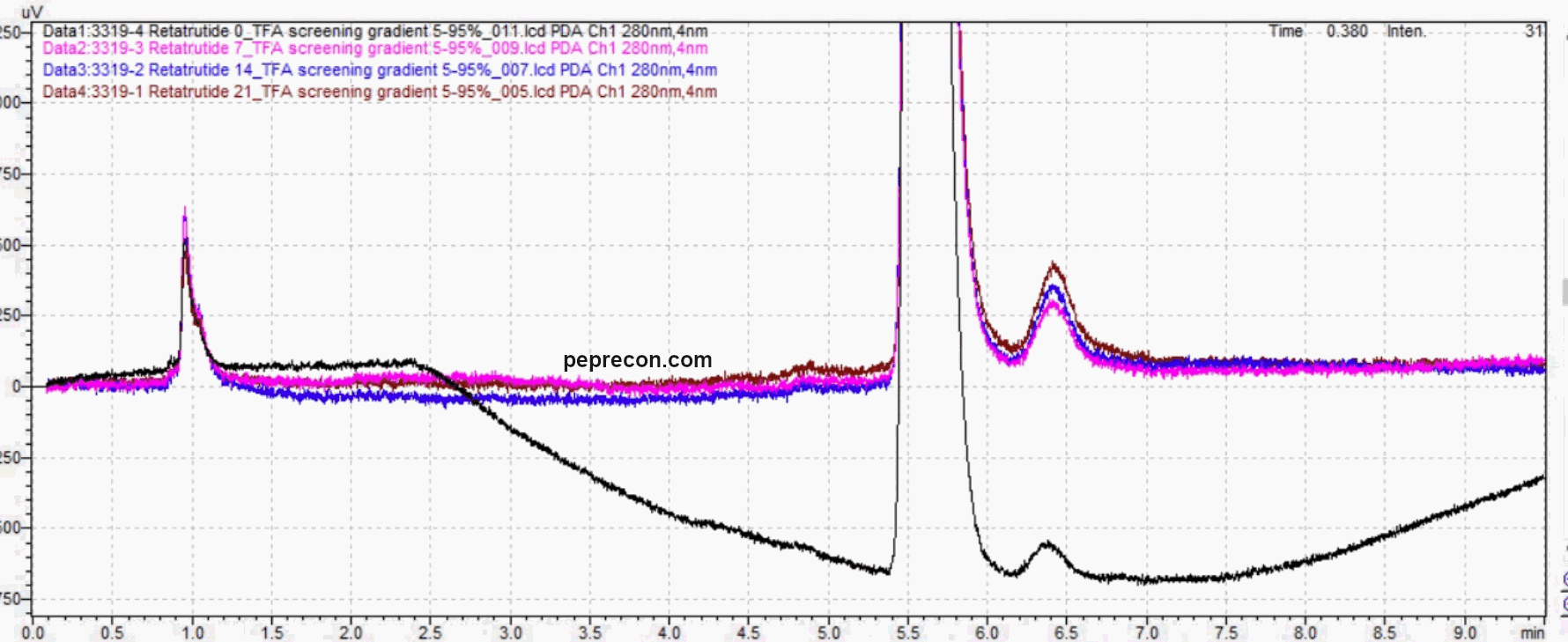
Janoshik’s exported overlay (test 293): the four heat-exposure runs, day 0 through 21, nearly superimposed. This is the chromatogram behind the “beautifully linear” remark.
So a few weeks in a hot delivery truck is not what damages lyophilized retatrutide. Sealed and dry, the powder is the last thing to worry about; the clock only starts once you reconstitute.
Findings
- Reconstituted and refrigerated, it holds for months. Purity stayed near baseline; mass declined slowly (single-digit percent over 60 to 90 days) in the well-behaved vials.
- Diluent matters. Bacteriostatic water retained roughly three times more peptide than ultrapure water in a same-kit comparison (−2.4% versus −7.9% over 90 days).
- Room temperature is faster and noisier than refrigeration, but weeks at room temperature were not catastrophic.
- Freezing the reconstituted solution did not help and, in a same-product comparison, lost mass faster than steady refrigeration. This does not apply to the lyophilized powder.
- Rare catastrophic single-vial failures happen. One refrigerated vial dropped to 57% purity in 90 days while its peers held.
- The lyophilized powder is the durable state. It tolerated up to ~21 months of storage and three weeks at 130 °F with only slow, linear purity loss and no mass loss.
Limitations
A few worth naming explicitly:
- Mostly N = 1 per condition. Most conditions rest on a single vial, which cannot separate a condition’s effect from vial-to-vial variability, as the SSA outlier shows.
- The study designs varied. Different intervals, products, and vendors, run at different times for different questions. They were never one unified experiment, so same-product comparisons (616 vs 624, the two arms of 683) are more reliable than cross-test ones.
- Mass and purity measure different things. Reported mass is total recovered peptide; purity is the fraction of that mass that elutes as intact peptide by HPLC. A vial can lose mass while purity holds (physical loss or adsorption) or hold mass while purity drops (chemical degradation), and the two sometimes diverge. Mass can also fall while purity holds for a procedural reason: labs typically filter the sample before each run to protect sensitive instruments, which removes aggregated or particulate material and lowers the recovered mass without changing the purity of what passes through.
- Measurement variance is real. As test 715’s bouncing purity readings show, single-point assay noise can run to several percent.
- Vendor and lot specificity. Results attach to the specific products and lots tested; other lots may differ.
Conclusion
Retatrutide is a durable compound with a few clear weak points. Once reconstituted, it stays stable for months in the fridge if it is mixed with real bacteriostatic water rather than ultrapure water; it degrades faster at room temperature, and freezing the solution does not help. As a dry, lyophilized powder it barely changes at all, whether over years of storage or weeks of sustained heat. Single-vial failures are rare but real, which is why any one result, including these, deserves caution.
Downloads
References
-
Retatrutide (LY3437943) is an investigational once-weekly GIP, GLP-1, and glucagon receptor triple agonist. It is not an approved medicine. All testing described here was conducted on gray-market research material by independent third-party analytical laboratories and is presented for educational purposes only. ↩