A certificate of analysis (COA) is a laboratory’s report on a sample it was given. In this space it is the main signal anyone has about what is in a vial, and it is also the most misread document in the hobby. People glance at a purity percentage, see “99%,” and stop. That single number, read alone, routinely misses vials that are mislabeled, underfilled, or backed by a COA that was never about their product at all.
A good COA answers three separate questions, by three different methods. This article works through what each one means, who ran the test and why that matters, and a set of real lab reports (identifying details redacted) that show the full range from a strong result to three very different failures. It closes with how to confirm a COA is genuine.
The three questions
Identity: is it the right molecule? Answered by mass spectrometry, usually liquid chromatography-mass spectrometry (LC-MS). The instrument measures the molecular weight of what is in the sample; the lab compares the observed mass to the known theoretical mass of the claimed peptide.1 On a COA this often appears simply as Identity: Confirmed, ideally with the method named. Identity is the question most people skip, and it is the one two of the failed reports below turn on.
Purity: how intact is the peptide fraction? Answered by high-performance liquid chromatography (HPLC), typically with UV detection. The sample is separated on a column and the detector records each component as a peak. Purity is a math result: the area of the main peak as a percentage of all integrated peak area, the fraction of the peptide-related material that conforms to the reference standard rather than being truncated chains, deletion sequences, or other related impurities.2 It is a statement about the peptide relative to itself, nothing more. What purity is not: a cleanliness score for the vial. The measurement only describes the peaks the detector sees, so a non-peptide contaminant that does not show up in that window simply is not in the number. A vial could carry a genuinely harmful non-peptide adulterant and still report 99.5% purity, because the 99.5% was never about the whole vial in the first place.
Content: how much is actually in the vial? Answered by quantitation: the lab measures the mass of peptide present, usually against a reference standard. This is the number that sets your real dose, and it is the one most often missing, or quietly failing.
The single most important thing to understand is that purity and content are not the same number, and neither one is a safety screen.
Purity is not content
HPLC purity is a percentage of the peptide material the detector sees. It says nothing about how much peptide is in the vial, because it does not count water, salts, residual solvents, or the counter-ions left over from synthesis; none of these absorb UV the way the peptide does.2 A peptide can therefore be 99% pure and still only 70-85% net peptide content by mass: intact peptide, but the vial’s mass is partly water and salt. Two vials can both report 99% purity while one contains noticeably more actual peptide than the other.
Here is the purity math in its raw form, from a real chromatogram (this sample returns later in the failure section):
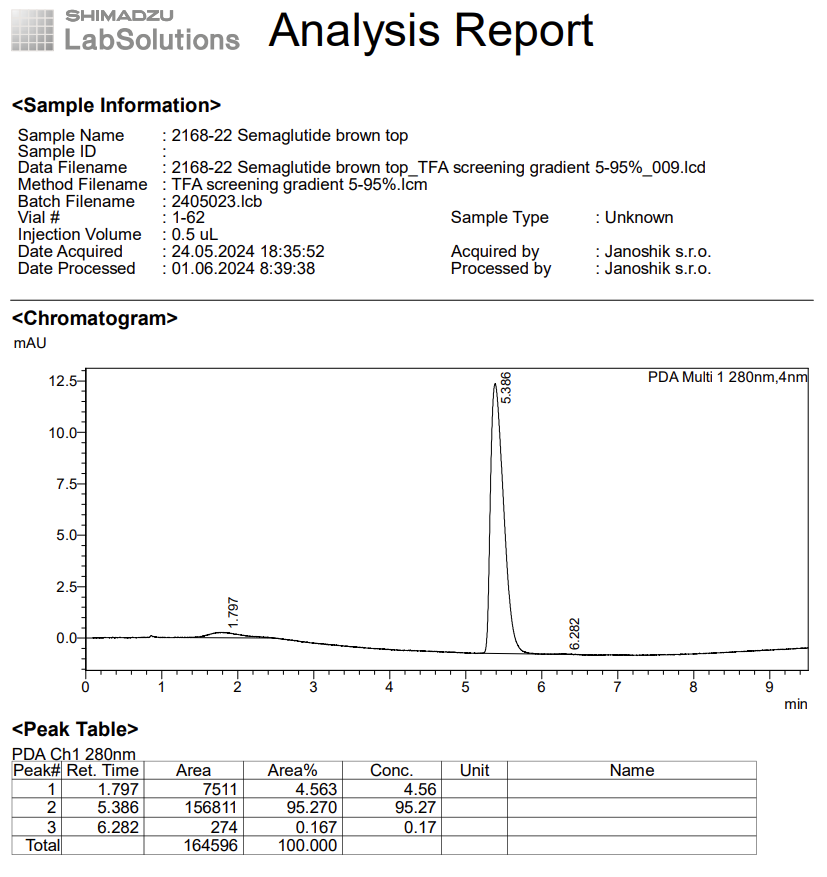
The purity number is literally this division. The instrument integrates the area under every peak; the main peak here holds 95.270% of the total area, so the report says purity 95.270%. The 4.563% peak at 1.8 minutes is a second peptide, which is why this particular sample shows up again below. Nothing outside these peaks exists as far as the purity figure is concerned.
For dosing, content is the number that matters, and a high purity figure with no content figure is an incomplete report. The good news is that the better labs report both, often alongside the actual milligrams found.
Who ran the test matters
The same analytical work carries very different weight depending on who commissioned it. Testing in this space comes in three forms:
First party: the manufacturer tests its own product. Always taken with a grain of salt. The seller controls which vials go to the lab, so cherry-picking a good vial or presenting one good batch as representative of all batches is trivially easy. Some manufacturers do not even test finished vials: the impressive document they send describes the raw material that went into the formulation, not the lyophilized vial you receive. (More on spotting that document type below.)
Second party: a group-buy operator tests the buy. In a group buy, the operator commonly builds testing into the per-kit cost and sets aside a number of vials from that exact buy to send off. This is meaningfully better than first-party paper, because the vials come from the same production run the participants receive, but it is exactly as trustworthy as the operator running it. Know whose judgment you are borrowing.
Third party: end users test what they actually received. The gold standard. Individual buyers crowd-fund lab fees and submit vials from their own orders: people who joined the same group buy, bought from the same manufacturer in the same window, or simply want the data to exist. Nobody in the chain of custody has an incentive to make the product look good. The research data on this site comes from exactly this kind of community testing, and its founding principle applies to every COA you will ever be shown: do not trust, verify, ideally with your own vial.
Every report shown below is third-party testing of this kind, from Janoshik Analytical, with task numbers, clients, batches, and verification keys redacted.
A strong report, read line by line
This is what a good outcome looks like. The sample was submitted for a blind test: the lab was told only that it was one of the common GLP-1 peptides (semaglutide, tirzepatide, or retatrutide) and asked to determine which, rather than being told the answer. Blind testing is the strongest form, because identity is earned instead of assumed.
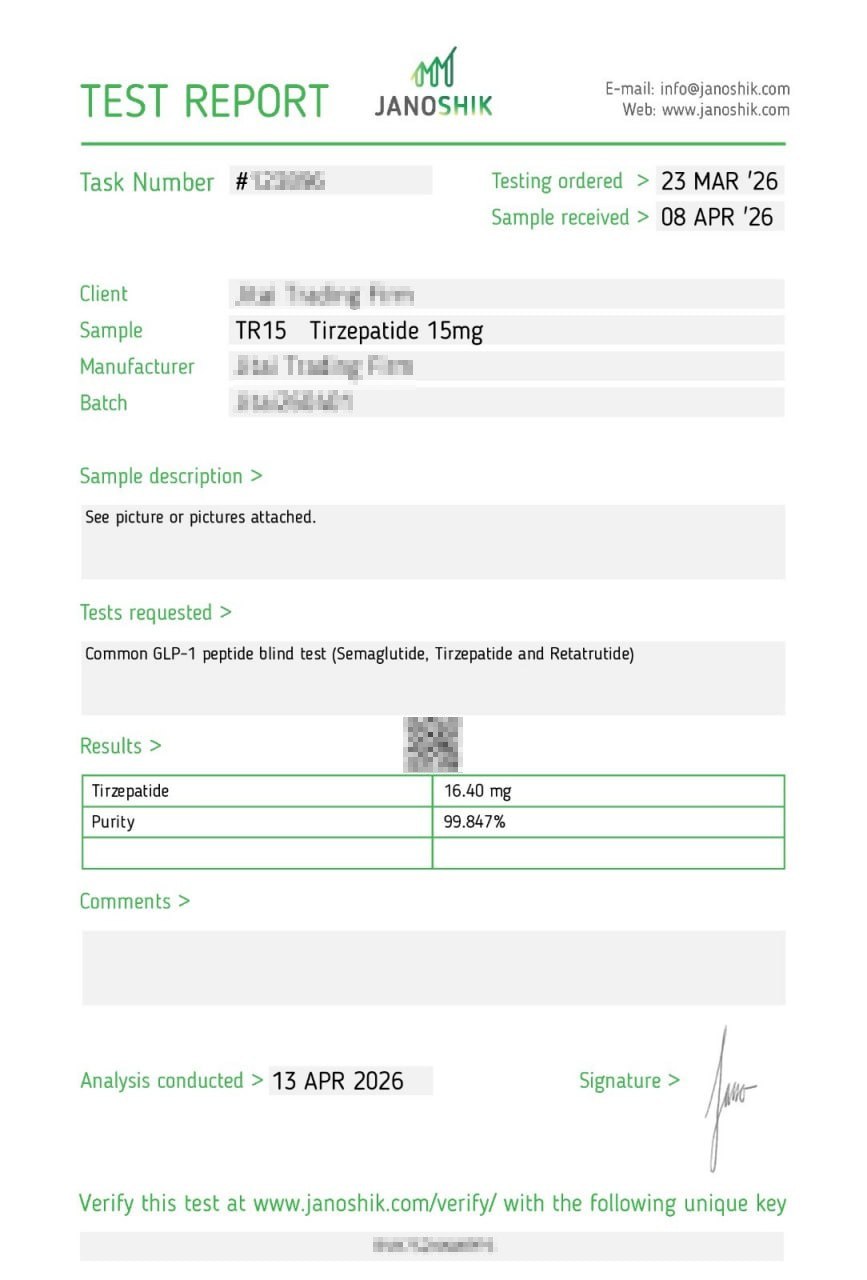
The sample was sold as tirzepatide 15 mg. The lab, asked only “which GLP-1 is this,” returned: tirzepatide, 16.40 mg, purity 99.847%. All three questions answered: identity (earned through the blind format), content (16.40 mg against a 15 mg label, a healthy fill), and purity. The report also carries a QR code and unique key (redacted here) for verification against the lab’s database.
Three things make this strong. It is blind, so the compound name is the lab’s finding, not the label’s claim. It reports content and purity together, so you know both what it is and how much. And it is verifiable against the issuing lab rather than taken on faith.
Same purity, wildly different vials
Purity tells you nothing about consistency either. This report covers three vials from the same batch, labeled 18 mg:
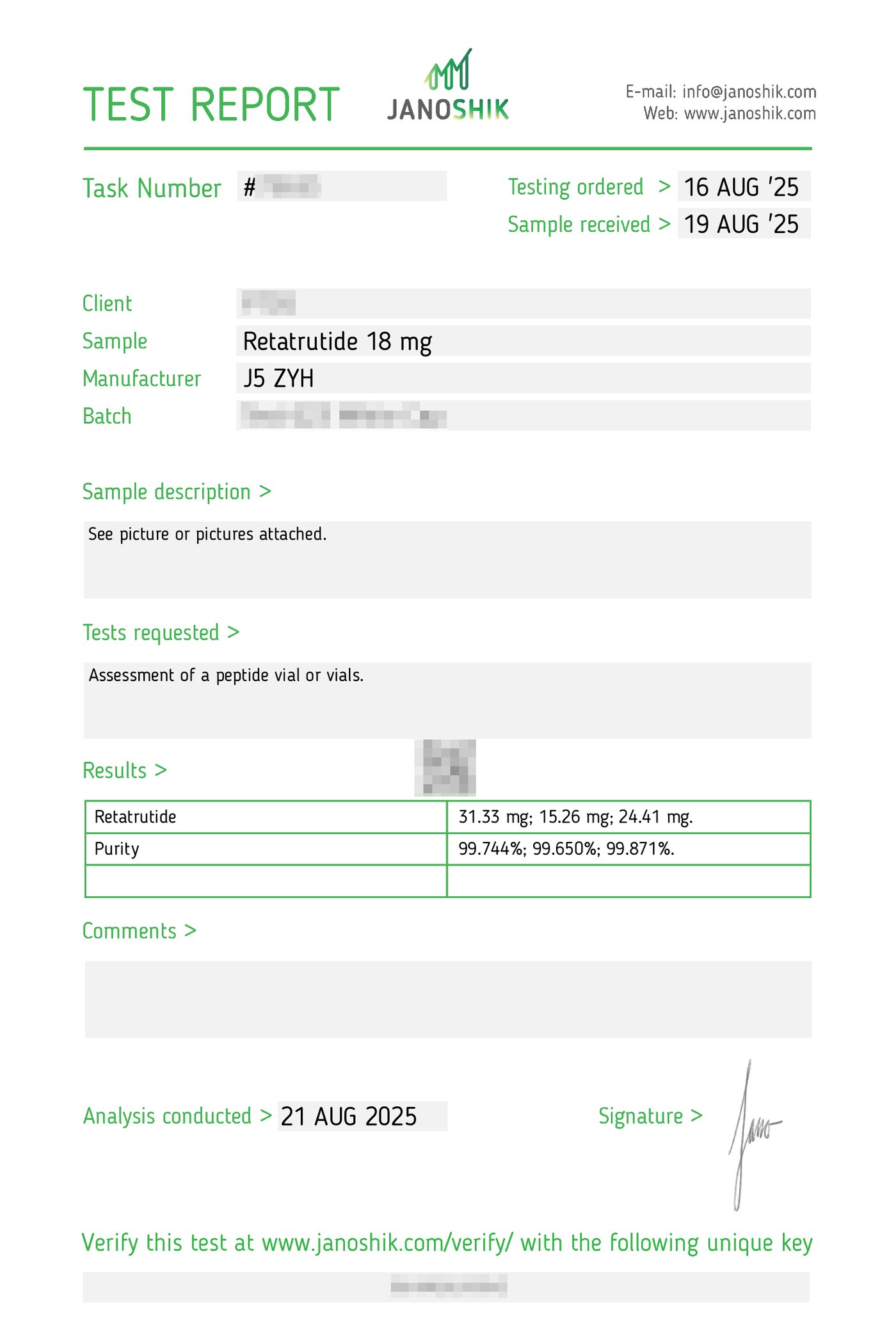
Three vials of the same product, labeled 18 mg each: 31.33 mg, 15.26 mg, and 24.41 mg. The purities are 99.744%, 99.650%, and 99.871%, essentially perfect across the board. A purity-only reading calls this batch excellent. The content column shows a vial-to-vial swing of more than 2x, which for a titrated compound means the “same” weekly dose could double without the user changing anything.
This is the strongest practical argument for multi-vial testing: a single-vial result, however good, is one draw from a distribution, and this distribution was wide.
How a blend is reported
A multi-component product is reported per component. This LC-MS certificate covers a three-peptide “Glow” blend:
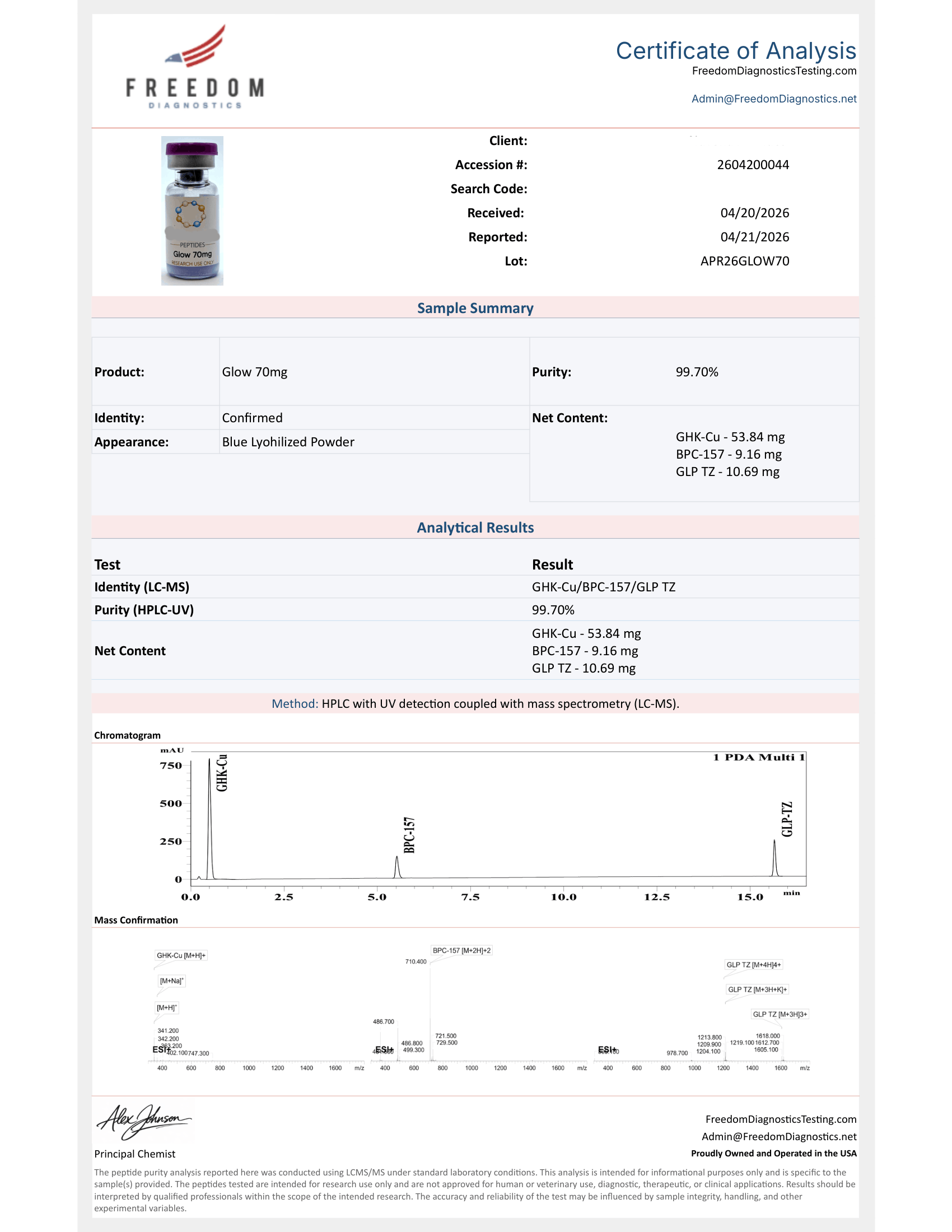
A full LC-MS certificate for a blend. Identity is confirmed for all three peptides; purity is reported by HPLC-UV; and net content is broken out per component (GHK-Cu, BPC-157, and the GLP compound each in mg). The chromatogram below shows one labeled peak per peptide, and the mass-confirmation panel shows the spectra behind the identity call. This is what “all three questions, answered, with the underlying data shown” looks like.
What failure looks like
A COA is only useful if you are willing to read a bad result as a bad result. Here are three real failures, each a different mode.
Failure 1: the wrong peptide, and barely any of it. Sold as ipamorelin, 5 mg:
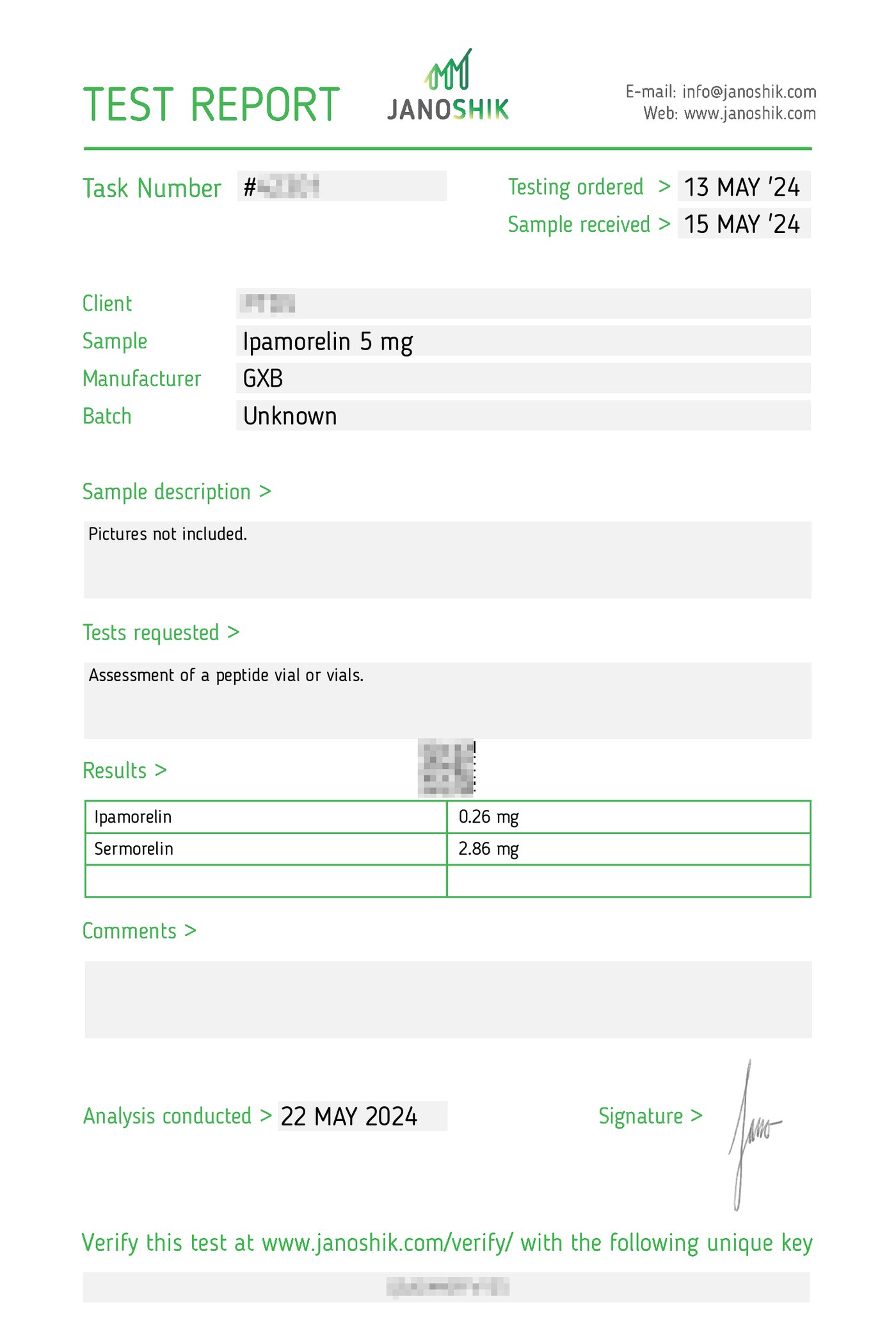
The lab found 0.26 mg of ipamorelin and 2.86 mg of sermorelin: the dominant peptide in the vial is not the one on the label, and the labeled compound is present at about 5% of its claimed amount. No purity number rescues this vial. Only identity and content, read together, tell the story.
Failure 2: the right peptide, plus a stowaway. Sold as semaglutide, 5 mg. This is the sample whose chromatogram appeared earlier:
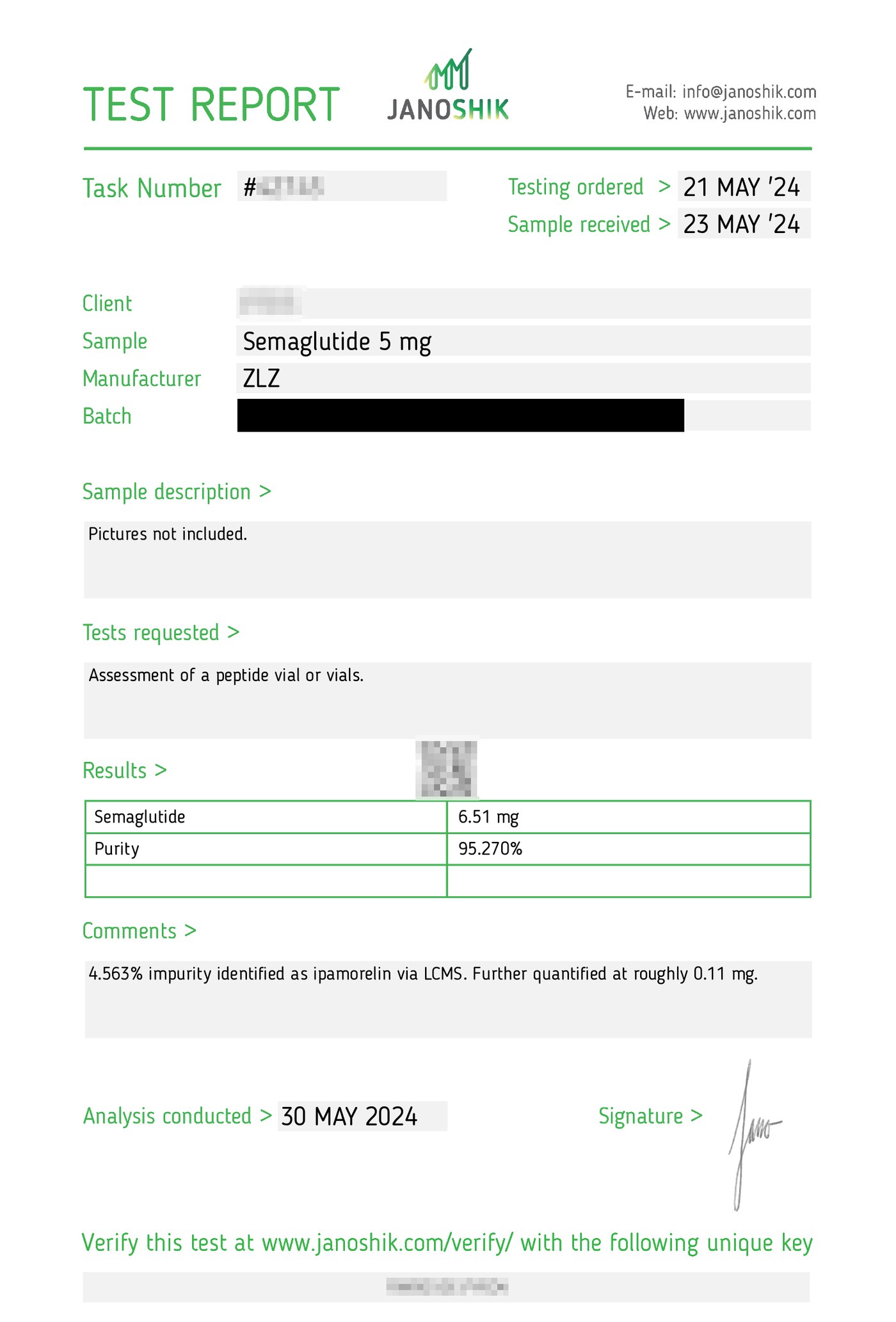
Identity and content look fine: semaglutide, 6.51 mg on a 5 mg label. But purity is 95.270%, and the comment explains why: 4.563% of the peptide material is ipamorelin, a completely different peptide, presumably from contamination in manufacturing. The buyer of this vial is taking a second active compound they never chose. This is the failure mode purity actually can catch, when the contaminant is a peptide that shows up in the window; a sub-99% purity on a modern synthesis deserves an explanation, not a shrug.
Failure 3: nothing in the vial at all. Sold as tirzepatide, 30 mg:
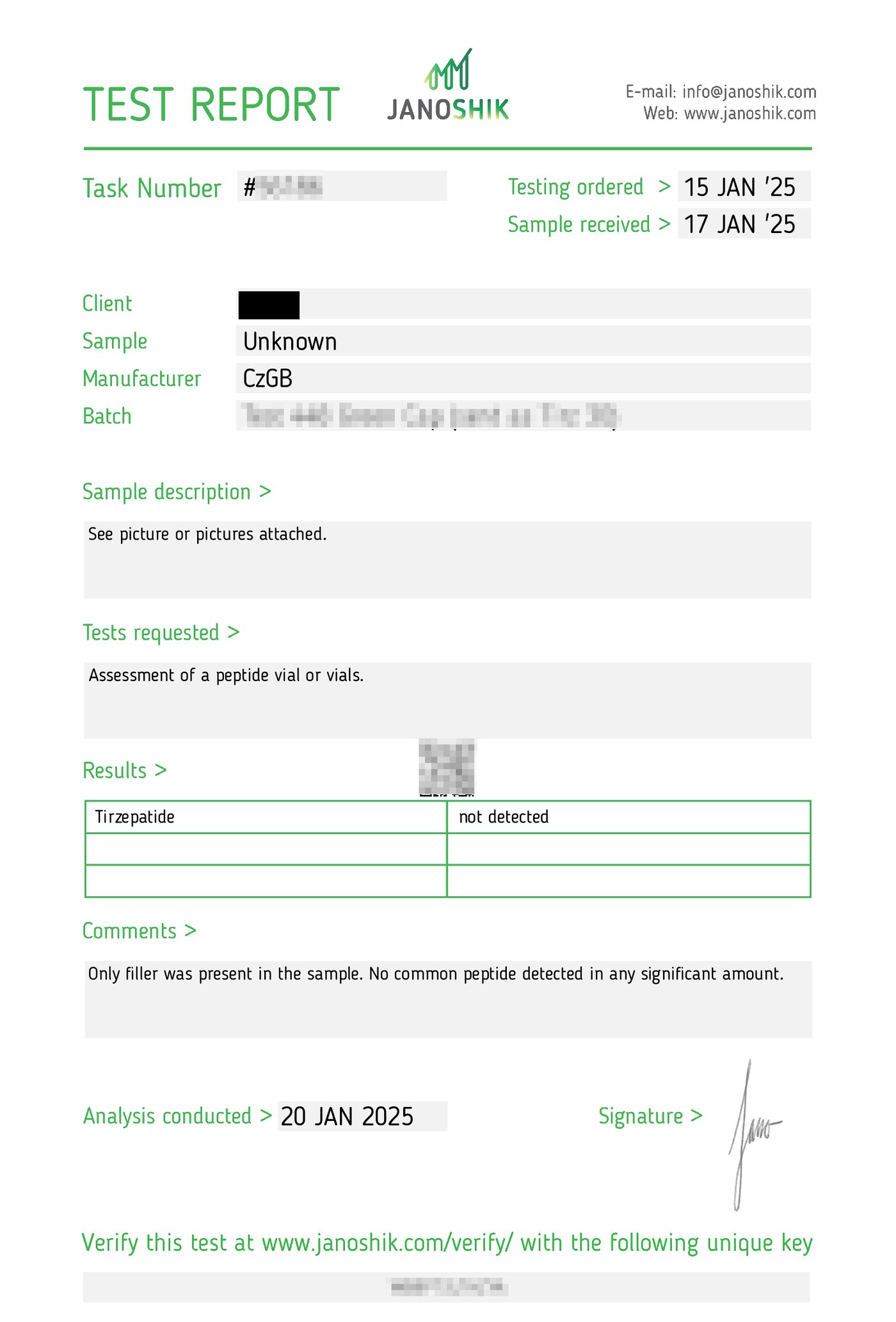
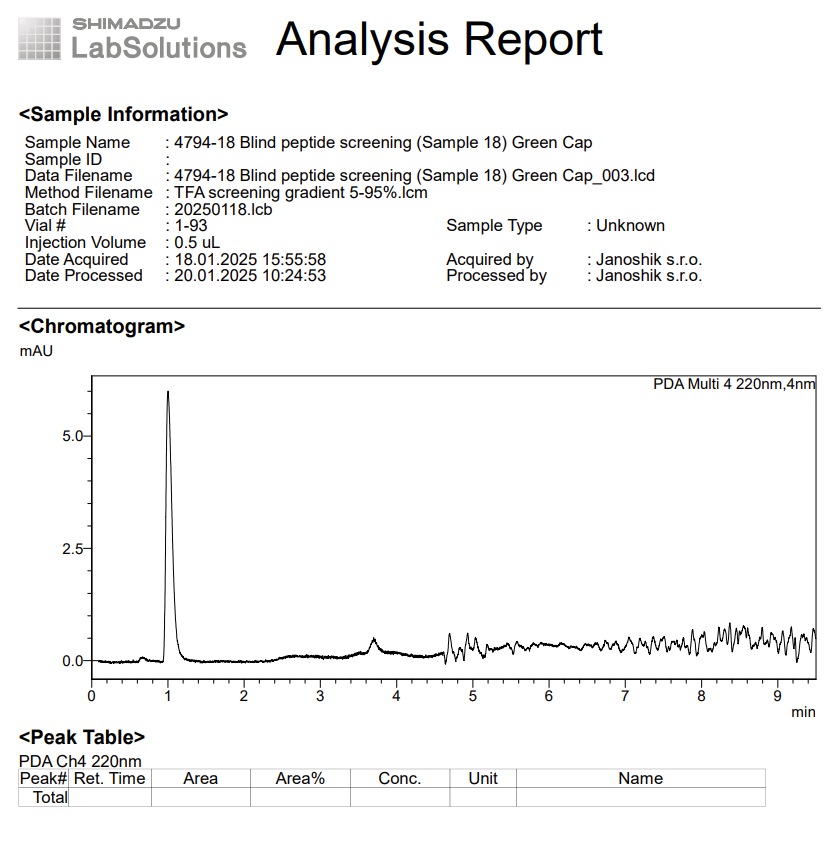
The result line reads “not detected.” The lab’s comment: “Only filler was present in the sample. No common peptide detected in any significant amount.” The chromatogram below is what that looks like in the raw data: one early filler peak and an otherwise empty baseline. There is no purity number at all, because there is nothing to measure.
Three failures, three different lessons: substitution is caught by identity, contamination shows up as depressed purity with an explanation, and an empty vial produces no numbers at all. A buyer reading only “purity” would have caught exactly one of the three.
The COA that isn’t about your vial
Not every impressive-looking document is a test of the product you received. This one is a manufacturer’s raw-material COA, the first-party document type from the tiers above:
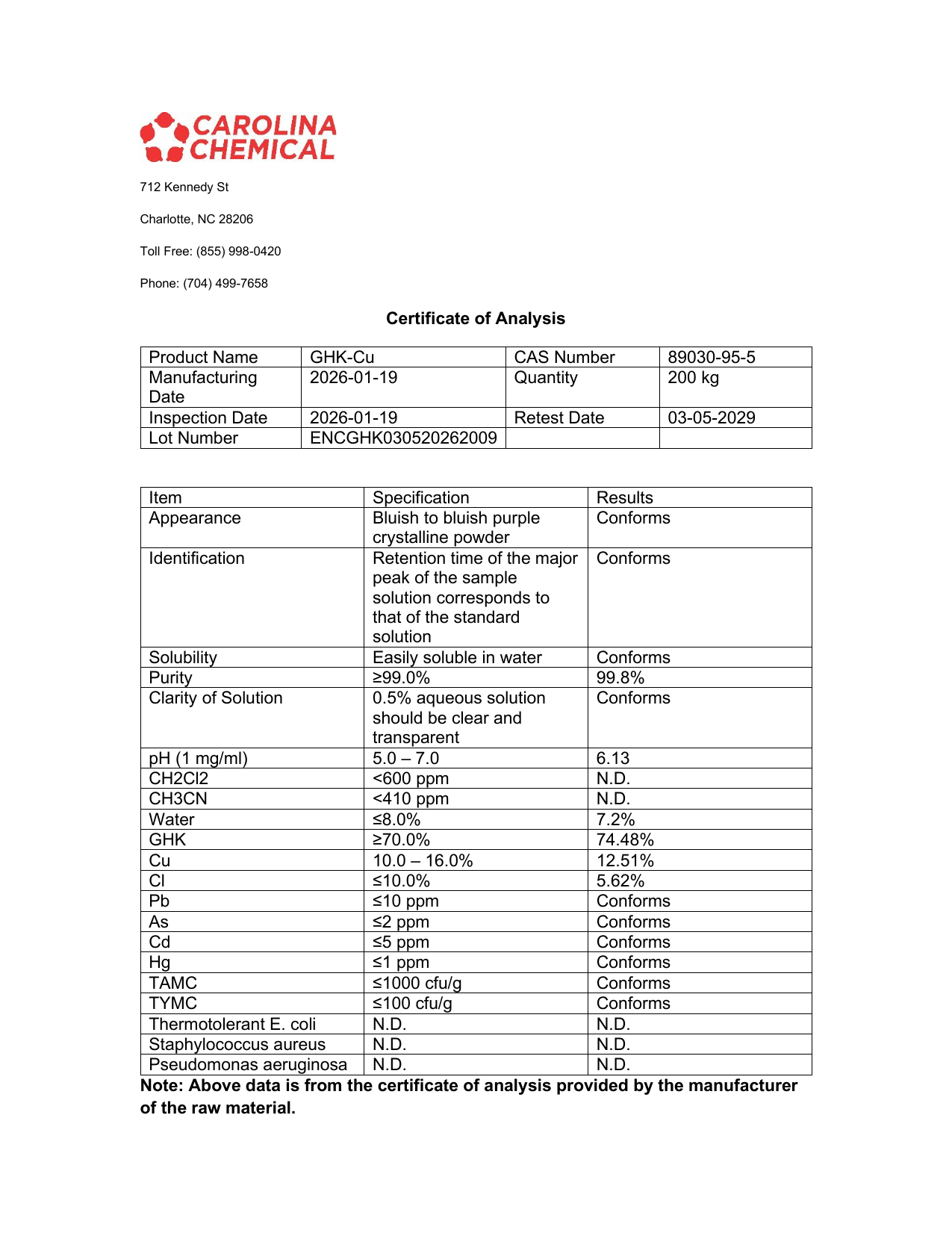
A bulk raw-material COA. It is detailed and pharma-styled (heavy metals, residual solvents, microbial limits, water content), but read the fine print: the quantity is 200 kg, and the note states the data come from the manufacturer of the raw material. This describes an enormous bulk lot of powder at the synthesis stage, self-reported, not an independent test of the finished vial in your hand.
Raw-material COAs are legitimate documents, but they answer a different question than “what is in this vial.” They describe the bulk powder a vendor purchased, often months earlier and in industrial quantities, and they are supplied by the manufacturer rather than by an independent lab. Treat them as background on the source material, not as verification of your specific product.
Verifying a COA, and spotting a fake
Because a COA is just a PDF or an image, it can be edited, reused across batches, or fabricated outright, and all three happen. The defenses are concrete:
Verify the report against the lab. The reason labs print a unique key or QR code is that results are published to a database you can query directly. With a Janoshik report, entering the key at the lab’s verification page returns the original data for that report ID, independent of whatever the seller sent you.3 A report that cannot be verified at the issuing lab is worth no more than the image file it came in. (The keys are redacted in the reports above for exactly that reason: they belong to the people who paid for the tests.)
Check that the batch matches your vial. A genuine COA is tied to a specific batch or lot. One COA reused for every batch a vendor sells, or a lot number that does not match your product, means the document is not evidence about what you have.
Require all three questions, by a named third-party lab. Identity by MS, purity by HPLC, and content in milligrams, issued by an independent laboratory rather than the seller. Accreditation such as ISO/IEC 17025 is a further signal that the lab’s methods are validated.4 Alongside Janoshik, labs the community regularly uses include Freedom Diagnostics, Peptide Test (TrustPointe Analytics), Chromate, Vanguard Laboratory, and BT Labs.
Our COA Reader automates the first pass of this: it reads a COA, pulls out the identity, purity, and content fields, runs internal consistency checks, and points you to the issuing lab’s own verification where one exists, including the labs named above. It does not confirm that your physical vial matches the document; nothing short of testing your own vial can. But it makes the three numbers and the verification path easy to see.
What a COA cannot tell you
Even a genuine, verified, complete COA has hard limits worth stating plainly:
- It tests a sample, not necessarily your vial. Unless you sent in your own unit, the report describes whatever the vendor submitted, which may or may not represent what shipped to you. The three-vial retatrutide report above shows how much room that leaves.
- Purity is not a contaminant screen. The purity percentage describes the peptide fraction relative to its own reference standard. Non-peptide contaminants that do not appear in the analytical window, from residual solvents to genuinely harmful adulterants, are invisible to it. Tests for those (heavy metals, endotoxin, sterility, TFA content) are separate line items that exist only if someone ordered them.
- It is silent on anything not ordered. Sterility, endotoxin, and bioburden are separate tests; if they are not on the report, they were not done.
- It says nothing about handling after testing. Reconstitution, storage, and stability are on you, and a good COA does not survive a mishandled vial.
- Identity and purity are not safety. Confirming a molecule and its purity is not a statement that the substance is safe or appropriate to use.
Conclusion
A certificate of analysis is worth reading carefully and worth distrusting by default. Read three numbers, not one: identity (is it the right molecule, by mass spec), purity (how intact the peptide fraction is, by HPLC, remembering it describes only the peptide fraction), and content (how many milligrams are actually there). Weigh who commissioned the test: a manufacturer’s own paper, a group-buy operator’s set-asides, and end-user crowd-sourced testing are three different levels of evidence. Insist that an independent lab produced it, that the batch matches your vial, and that the report verifies against the lab’s own database. The real reports above show the full range: a strong blind test, a perfect-purity batch with a 2x fill swing, a clean blend certificate, three distinct failures, and a document that was never about the finished product at all. The difference between them is visible only if you read past the purity line.
References
-
Peptide identity is confirmed by mass spectrometry, commonly electrospray ionization (ESI) LC-MS or MALDI-TOF, by matching the measured molecular weight to the theoretical mass of the claimed sequence. Identity confirmation answers a different question than purity: purity can be high while the molecule is the wrong one. ↩
-
HPLC (reversed-phase, UV-detected) purity is reported as the area of the main peak as a percentage of total integrated peak area. It reflects only UV-absorbing, peptide-related species within the analytical window and does not account for water, salts, counter-ions, non-chromophore content, or non-peptide contaminants that fall outside the method. This is why HPLC purity (“area %”) and net peptide content (“how many mg of peptide are present”) are distinct figures, why a peptide can be ~99% pure yet substantially less than 99% peptide by mass, and why purity is not a statement about everything in the vial. ↩↩
-
Janoshik Analytical (based in Prague, Czech Republic) publishes test results to a publicly queryable database; a report’s unique key or QR code can be entered at the laboratory’s verification page to return the original data for that report ID, which defends against edited or reused documents. Other independent labs used in this space include Freedom Diagnostics, Peptide Test (TrustPointe Analytics), Chromate, Vanguard Laboratory, and BT Labs; several offer their own online verification, which our COA Reader links when it recognizes the lab. ↩
-
ISO/IEC 17025 is the international standard for the competence of testing and calibration laboratories; accreditation to it indicates a lab’s analytical methods have been formally validated. It is a quality signal, not a guarantee about any individual sample. ↩