USP General Chapter <797> directs that multi-dose containers used in compounding be discarded within 28 days of first puncture unless the manufacturer specifies otherwise.1 For bacteriostatic water for injection (BAC water), the operative question is whether the preservative (typically benzyl alcohol) remains at an effective concentration for the duration of use.
We ran a 120-day stability assessment on Hospira-brand BAC water under three storage conditions, measuring benzyl alcohol concentration by liquid chromatography at five time points. All testing was performed by Janoshik Analytical, an independent third-party laboratory; the figures reported below are taken directly from the certificates of analysis (COAs) Janoshik issued for each time point.
This data has been provided by the members of PTDS, a crowdsource research peptide testing community. All relevant studies were designed, paid for in full, and run by PTDS, and every measurement in this article comes from their members' efforts. PepRecon is the host and publisher, not the source: the research, and the credit for it, belongs to PTDS.
Study design
Three 30 mL vials of Hospira BAC water were assigned to the following conditions:
| Storage | Air exposure | Withdrawal pattern |
|---|---|---|
| Room temperature | Monthly | Only on test days (day 0, 30, 60, 90, 120) |
| Room temperature | Weekly | 1 mL removed weekly with air replacement |
| Refrigerated (~4 °C) | Weekly | 1 mL removed weekly with air replacement |
Room Temperature with Monthly Use BAC serves as a low-disturbance control. Room Temperature with Weekly Use BAC simulates a typical user’s withdrawal pattern at room temperature. Refrigerated with Weekly Use BAC tests whether refrigeration affects degradation under the same use pattern.
Benzyl alcohol concentration was measured by Janoshik Analytical and reported in mg/mL on the COA for each sample and time point. The typical preservative concentration in commercial BAC water products is 0.9% v/v (approximately 9.4 mg/mL of pure benzyl alcohol, though density and assay methods vary). The literature-supported lower bound for effective preservation in injectable formulations is 0.5% v/v.2
Results
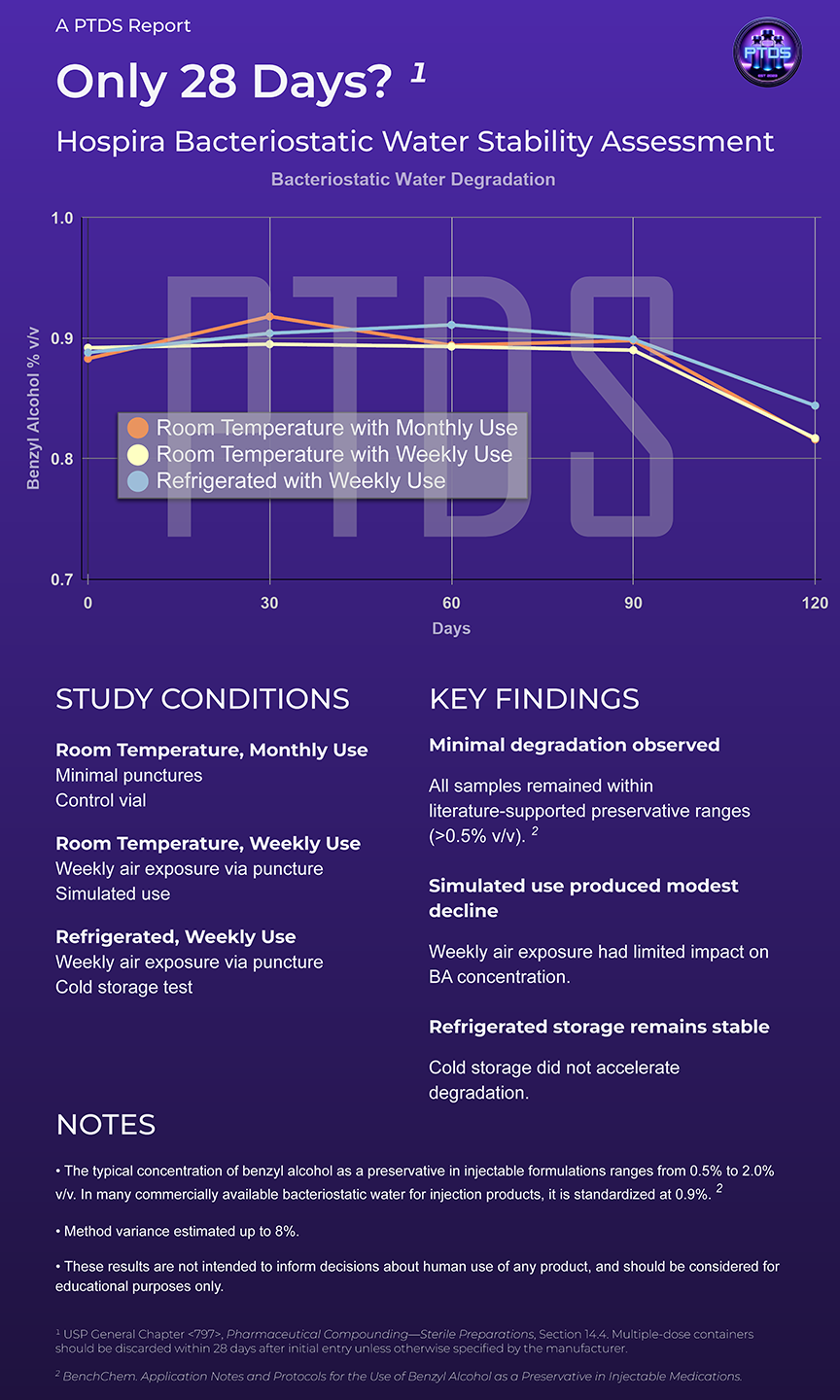
The full measurement table:
| Sample | Day 0 | Day 30 | Day 60 | Day 90 | Day 120 |
|---|---|---|---|---|---|
| Room Temperature with Monthly Use | 0.883 | 0.918 | 0.894 | 0.898 | 0.816 |
| Room Temperature with Weekly Use | 0.892 | 0.895 | 0.893 | 0.890 | 0.817 |
| Refrigerated with Weekly Use | 0.888 | 0.904 | 0.911 | 0.899 | 0.844 |
All values mg/mL. Method variance estimated at up to 8%.
The 28-day mark (day 30 here, closest available data point) showed essentially no change from baseline in any of the three samples. Across the first 90 days the three samples tracked closely, with values fluctuating within method variance and no clear downward trend.
Between day 90 and day 120, all three samples showed a meaningful drop:
- Room Temperature with Monthly Use BAC declined 9.13% from its day-90 value
- Room Temperature with Weekly Use BAC declined 8.20%
- Refrigerated with Weekly Use BAC declined 6.12%
Despite these drops, all three samples remained well above the 0.5% v/v effectiveness floor at day 120.
Findings
The 28-day mark is not where degradation begins.
In this dataset, benzyl alcohol concentration was statistically unchanged through day 90 across all three conditions. The USP <797> 28-day window for multi-dose containers appears to be driven by sterility and contamination considerations rather than preservative degradation per se.
Simulated use had limited measurable impact.
Room Temperature with Weekly Use BAC (weekly withdrawal + air exposure at room temperature) tracked closely with Room Temperature with Monthly Use BAC (minimal disturbance) for the first 90 days, suggesting that routine vial entries with sterile technique do not substantially affect preservative concentration over that horizon.
Refrigeration did not accelerate degradation.
Refrigerated with Weekly Use BAC (refrigerated, same use pattern as Room Temperature with Weekly Use BAC) showed slightly lower terminal decline than its room-temperature counterpart. Although the manufacturer’s product labeling stipulates room temperature storage, refrigeration appears neither to harm nor to meaningfully extend preservative stability under these conditions.
A consistent drop appeared between day 90 and day 120.
All three samples, including the minimally-disturbed control, showed roughly 6-9% decline in this window. This suggests an intrinsic degradation pathway independent of withdrawal frequency, though the magnitude is small enough that the samples remained above the literature-supported effectiveness floor.
Limitations
A few worth naming explicitly:
- N = 1 per condition. This is a feasibility-scale assessment, not a powered study. The single-vial-per-condition design cannot distinguish vial-to-vial variability from condition effects.
- Method variance up to 8%. The day-to-day measurement variability is on the same order as the changes observed in the first 90 days, which is why we describe those as “essentially unchanged” rather than asserting specific small movements.
- Benzyl alcohol concentration is a proxy for preservative effectiveness, not a direct measure. Effective microbial inhibition depends on additional factors not measured here.
- No microbiological challenge testing. This study measures the chemical preservative, not the actual bacteriostatic performance against contamination.
- One brand, one lot. Results may not generalize to other manufacturers or other lots of the same product.
Conclusion
In this 120-day assessment, Hospira BAC water maintained benzyl alcohol concentration above the literature-supported preservative effectiveness floor across three storage and use conditions, with the largest declines occurring between day 90 and day 120. The data do not support the conclusion that preservative degradation drives the USP <797> 28-day window for multi-dose containers.
Downloads
References
-
USP General Chapter <797>, Pharmaceutical Compounding: Sterile Preparations, Section 14.4. Multiple-dose containers should be discarded within 28 days after initial entry unless otherwise specified by the manufacturer. ↩
-
BenchChem. Application Notes and Protocols for the Use of Benzyl Alcohol as a Preservative in Injectable Medications. The typical concentration of benzyl alcohol in injectable formulations ranges from 0.5% to 2.0% v/v, with 0.9% standard in many commercial BAC water products. ↩